From VPN to Zero Trust – Is Your Vault Ready for Tokenized Asset Custody?


Why does a VPN still feel sufficient in a world where tokenized assets settle in real time?
Not long ago I watched a security engineer argue with a network admin over a VPN certificate, while a team awaited access to a digital vault housing tokenized collateral. It was a small moment, but it exposed a larger truth: the way we connect to custody infrastructure often lags behind what the assets demand. Tokenized real-world assets are moving from pilots into core market infrastructure. Settlement is faster, liquidity is tighter, and the regulatory framework surrounding custody is tightening too. In this environment, the old habit of dialing into a private network and hoping for robust protection begins to look like a brittle shield in a world of distributed risk.


Is VPN really the barrier we want between critical private keys and a potential adversary who might be lurking in the shadows of a cloud network? The question is not a rhetorical one. It is a hinge point for how the industry defines trust in a custody ecosystem that increasingly relies on cross-chain flows, real-time collateral management, and insured storage. Recent developments illustrate both the opportunity and the risk. The DTCC has showcased tokenized real-time collateral management on modern platforms, signaling that tokenized collateral is no longer a curiosity but a scalable market infrastructure with real world impact. In Europe, MiCA regulatory activity is pushing institutions to implement custody under licensed frameworks, bridging traditional finance with crypto rails. Banks and market infrastructures are expanding custody offerings to include tokenized assets, sometimes paired with regulated services and insured storage. When you put these pieces together, it becomes clear that access control needs to be context aware, provenance grounded, and capable of supporting rapid, auditable transfers across chains.
So where does this leave us today? The core tension is between what a VPN protects you from and what a custody environment must withstand. A VPN guards network perimeters, but tokenized custody is a landscape of evolving actors, multi-party control, and diverse asset types. Access must be granular, just-in-time, and tied to a verifiable identity and a verifiable context. That is the heart of the shift toward zero trust network access and secure service edge architectures. It is not a rejection of VPNs, but a recognition that the strongest protection in this space is not a tunnel but a posture: identity verified, requests authorized by multiple signals, and access granted only for the exact task at hand.
Is VPN still enough for custody of tokenized assets?
In practical terms, a VPN affords a shield around a user’s device and a set of servers. It assumes trust inside the network and privileges that can be broad or poorly segmented. Tokenized assets, however, live in a matrix of custody accounts, cross-chain vaults, and real-time settlement rails. If a single credential is compromised, the exposure can cascade through multi-party agreements, cross-border transfers, and insurance layers. This reality is why regulators and practitioners alike are steering toward stronger identity controls, tighter session context, and more frequent attestation of the security posture before any sensitive operation is allowed.
A growing body of industry thinking points to a security architecture built on zero trust principles. Zero trust does not mean zero access; it means trusted access requires dynamic verification, least privilege, and continuous monitoring. In the custody context, this translates to identity verification that factors in device posture, network context, and the specific asset or action being requested. It also means replacing flat network trust with adaptive access that can be rescoped or revoked at a moment’s notice. The shift is supported by practical deployments and regulatory signals. For instance, governance and custody blueprints from U.S. and EU authorities emphasize mature cyber risk programs and segregated client assets, while market infrastructures explore licensable custody ecosystems that can interoperate with multiple licensed custodians.
If you are building or evaluating a custody solution today, start by mapping the access paths to vaults, settlement nodes, and data rooms. Ask who needs access, for what actions, and under what conditions. Then examine your architecture against the zero trust model rather than waiting for a single feature upgrade to fix fundamental design gaps.
The shift toward zero trust and the security primitives reshaping custody
The landscape is not just about removing VPNs. It is about adopting a set of integrated security primitives that can handle the realities of tokenized assets:
- Multiparty computation wallets and seedless onboarding: These enable programmable transfers and distributed control without a single point of failure. They also reduce the risk tied to human-readable keys and simplify onboarding for new participants in a custody arrangement.
- Cross-chain vaults and tokenized collateral management: Cross-chain custody supports tokenized assets across multiple networks and counterparties, aligning with platforms that demonstrate real-time settlement and auditable processes. This is what turns tokenized collateral into a use-case that can scale beyond pilots.
- Insurance-backed storage and regulated infrastructure: Insurance-enabled storage, alongside licensed custody ecosystems, provides a risk-transfer layer that institutional users increasingly demand. It is not only about security controls but about confidence for regulated markets.
- Wallet-as-a-Service and automated compliance: Turnkey custody capabilities that include KYC/AML workflows, regulatory reporting, and policy automation help reduce time-to-value for enterprises seeking to tokenize and custody diverse asset classes.
These elements are not abstractions. They are being embedded into the tools and platforms used by large banks, market infrastructures, and asset managers. The trend lines show convergence: regulated, bank-grade custody interfaces are integrating with DeFi-friendly features, and external vendors are offering modular components that connect into a single, auditable pipeline for tokenized assets.
A practical guide to evaluating custody access in a tokenized world
When you read the latest market briefs and regulatory updates, the practical questions remain the same: Do we have proper risk controls, do we understand the asset types we are protecting, and can we prove the custody model to regulators and auditors?
Here is a compact due diligence checklist you can adapt for a blog post or decision guidance:
- Regulatory alignment: Is the custodian licensed where assets are issued and traded? Do they support MiCA or applicable local regimes? How does the platform handle cross-border regulatory requirements?
- Custody scope: Which asset classes are supported and is cross-chain transfer possible with real-time settlement? Can tokenized RWAs be held with the same rigor as traditional securities?
- Security controls: Do they use MPC, hardware security modules, air-gapped vaults, and strict multi-identity access controls? What is the incident response plan and audit cadence?
- Insurance and risk coverage: Are assets insured, and what are the coverage limits and claims processes?
- Access architecture: Do they rely on VPNs, or do they implement zero trust with SSE? How is access authenticated, logged, and revocable in real time?
- Transparency and governance: What regulatory disclosures and third-party audits are provided? Are attestations available for the asset class and the platform architecture?
In practice, you may find yourself choosing between a VPN as a component of a larger access strategy and a full zero-trust posture that continuously proves trust rather than assuming it. The more mature approaches couple identity-driven access with context-aware controls and granular authorization policies. In European markets, institutional custody is being tested under MiCA frameworks, while U.S. guidelines emphasize segregated client assets and cyber risk maturity as baseline standards. Taken together, these trends push custody solutions toward a harmonized, auditable, and interoperable ecosystem rather than a collection of ad hoc protections.
Practical perspectives for those rolling this out
If you are responsible for security and governance in a custody environment, consider these action items as you plan or re-architect:
- Define the custody baseline: Clarify whether you are discussing crypto-native custody, tokenized RWAs, or cross-chain custody platforms. Anchor your discussion in the regulatory context so stakeholders understand the practical implications.
- Emphasize context-based access: Advocate for zero-trust access with just-in-time provisioning, device posture checks, and multi-signal authorization. This logic should apply to vault consoles, settlement nodes, and wallet interfaces.
- Highlight MPC and cross-chain capabilities: Explain how seedless onboarding and programmable transfers reduce risk and improve operational resilience. Describe cross-chain vaults as essential for tokenized assets across networks.
- Stress insured storage: Insurance-backed vaults provide a risk-transfer layer that complements cryptographic security and regulated storage.
- Build a transparent governance narrative: Offer clear reporting, audits, and attestations to satisfy regulators and reassure custodial clients.
The bigger question for the road ahead
As tokenized assets become more embedded in regulated infrastructures, the bar for secure remote access rises correspondingly. The industry is moving toward interoperable, licensable custody ecosystems that connect banks, custodian networks, and tokenization rails. The shift from VPN to zero trust is not merely a technology upgrade; it is a fundamental redefinition of how trust is established and maintained in real time.
So, where will your organization land in this shift? Will you adopt a pragmatic hybrid approach that blends VPN with contextualized zero-trust controls, or will you commit to a full zero-trust posture across all custody operations? And as the regulatory climate continues to evolve, how will you demonstrate continuous trust to auditors, clients, and regulators alike?
Should VPNs Be the Gatekeeper for Tokenized Asset Custody in Real-Time Markets?
I remember a tense morning in the security operations center where a veteran network administrator confronted a young engineer over a VPN certificate. The certificate was about to expire, the vault console hummed with real-time settlements, and a handful of tokenized bids waited in the data room. It was a small moment, but it captured a bigger truth: the way we connect to custody infrastructure often lags behind what the assets demand. Tokenized real-world assets are stepping out of pilots and into core market rails where settlement is instant, liquidity is tighter, and regulators are drawing clearer lines around custody. If our access controls don’t rise to meet that, we’re building trust on a foundation that’s already too porous.
What does this mean for the VPN you still rely on today? The quick answer is: it’s not that VPNs are evil; it’s that they’re not enough as a sole guardian for assets that travel across cross-chain rails, real-time collateral networks, and insured storage vaults. The industry is moving toward a posture where access is verified not just once at the edge, but continuously, in context, and with the ability to roll back privileges instantly if something looks off. This is the shift from a tunnel-based mindset to a trust-in-context mindset—zero trust, but with practical, bank-grade pragmatism.
Why custody matters when assets settle in real time
Tokenization promises faster settlement, better liquidity, and unprecedented transparency. But it also expands the attack surface: private keys now live in distributed vaults, custody providers must prove segregation of client assets, and transfers happen across networks that don’t share a single, uniform security model. In Europe, MiCA is nudging institutions toward licensed, regulated custody rails. In the United States, the SEC and related bodies are crystallizing expectations around segregated client assets and mature cyber risk programs. All of this is not abstract theory—it translates into concrete requirements for how we access, control, and audit custody environments.
DTCC’s demonstrations of tokenized real-time collateral management show that tokenized collateral is moving from pilot to scalable infrastructure. Across the Atlantic, banks and market infrastructures are expanding custody capabilities to cover tokenized assets, including cross-chain tokenization and insured storage. These shifts push custody solutions to be not only more capable but more auditable, interoperable, and compliant with evolving regulatory expectations. If you’re evaluating access architectures today, you must think about how to prove trust continuously, not just prove trust once at the perimeter.
VPNs useful, but not enough on their own
A traditional VPN is designed to shield traffic between a client and a network boundary. It assumes that once you’re inside the tunnel, you can access a defined set of resources. In a tokenized custody environment, that assumption is increasingly too blunt. A single compromised VPN credential could enable access to vault consoles, settlement nodes, or data rooms that are handling tokenized RWAs, cross-chain vaults, or real-time collateral positions. And because tokenized assets often involve multi-party agreements, rapid, auditable transfers, and cross-border implications, the consequences of lax access controls scale quickly.
What we’re seeing in practice is a layering of defenses: VPNs exist as one component, but they’re complemented—or sometimes replaced—by zero-trust network access (ZTNA) and secure service edge (SSE) architectures. In ZTNA models, access is not granted by virtue of network location; it’s granted by verifiable identity, device posture, contextual signals about the action, and dynamic authorization policies that can be tightened or loosened in real time. This is the difference between “you’re inside the tunnel” and “you’re allowed to perform this specific vault operation, at this moment, under these conditions.”
Regulators are paying attention. In the EU, MiCA and its RTS/ITS updates create a framework where custody offerings must align with licensable, interoperable infrastructures. In the U.S., the SEC’s custody blueprint emphasizes mature cyber risk programs and segregated client assets—a baseline that every custody provider should be able to demonstrate, not merely claim. These regulatory currents aren’t obstacles; they’re design constraints that push us toward safer, more transparent access models.
The security primitives reshaping custody access
If VPNs are the old gate, the new gatekeeper is a suite of security primitives that work together to deliver continuous trust:
- Multiparty computation (MPC) wallets and seedless onboarding
- Enable programmable transfers and distributed control without one single point of failure. They also simplify onboarding for new participants in a custody arrangement while reducing the risk tied to human-readable keys.
- Cross-chain vaults and tokenized collateral management
- Real-time settlement and auditable processes across multiple networks become practical, not aspirational, as cross-chain custody matures.
- Insurance-backed storage and regulated infrastructure
- Provides a risk-transfer layer that institutional users increasingly demand, complementing cryptographic security with traditional risk management.
- Wallet-as-a-Service (WaaS) and automated compliance
- Turnkey custody capabilities that embed KYC/AML workflows, regulatory reporting, and policy automation, speeding time-to-value for enterprises tokenizing diverse asset classes.
These elements aren’t isolated features; they’re parts of a connected ecosystem. A licensable custody network—think Fireblocks’ Global Custodian Partner Program or similar frameworks—connects licensed custodians, asset managers, and liquidity providers in a compliant, auditable mesh. The trend is toward interoperability: regulated banks, market infrastructures, and custody providers weaving together MPC, WaaS, insured storage, and cross-chain mechanics into a single pipeline for tokenized assets.
A practical guide to evaluating custody access in a tokenized world
Here’s a compact, blog-ready checklist you can apply when you’re assessing or writing about custody access in this new landscape:
- Regulatory alignment
- Is the custodian licensed where assets are issued and traded? Do they support MiCA or relevant local regimes? How do they address cross-border regulatory requirements? (References to EU and U.S. regulatory developments can be found in recent analyses and official documents.)
- Custody scope
- Which asset classes are supported (cryptocurrencies, tokenized RWAs, NFTs)? Is there cross-chain support and real-time settlement? Can tokenized RWAs be held with the same rigor as traditional securities?
- Security controls
- Do they employ MPC, hardware security modules, air-gapped vaults, and multi-identity access controls? What is the incident response plan and audit cadence?
- Insurance and risk coverage
- Are assets insured? What are the coverage limits and claims processes? Is there coverage for cross-border operational risk?
- Access architecture
- Do they rely on VPNs, or do they implement zero-trust with SSE? How is access authenticated, logged, and revocable in real time?
- Transparency and governance
- What governance disclosures and third-party attestations are available? How frequent are audits and what scope do they cover (asset class, network, governance controls)?
In practice, you’ll often confront a hybrid reality: VPNs as part of a broader access strategy, layered with zero-trust controls that verify identity, device posture, and context for every operation. The most mature approaches couple identity-driven access with granular, just-in-time authorization policies and continuous risk assessment.
Concrete steps you can take today
If you’re responsible for security and governance in a custody environment, here are concrete actions to start or re-architect your approach:
- Define the custody baseline and anchor it to regulation
- Decide whether you’re discussing crypto-native custody, tokenized RWAs, or cross-chain custody platforms. Tie your architecture to regulatory expectations (MiCA in the EU; SEC/FINRA-style expectations in the U.S.).
- Build a context-aware access model
- Move toward zero-trust with just-in-time provisioning, device posture checks, and multi-signal authorization. Apply these controls to vault consoles, settlement nodes, and wallet interfaces.
- Highlight MPC and cross-chain capabilities
- Explain how seedless onboarding and programmable transfers reduce risk and enable multi-party collaboration without single points of compromise. Emphasize cross-chain vaults as essential for scalable tokenized asset custody.
- Prioritize insured storage and regulated ecosystems
- Insurance-backed vaults should be part of the risk management narrative, not an afterthought.
- Create transparent governance and audit readiness
- Provide clear reporting, third-party audits, and attestations for the asset class and platform architecture. Regulators want evidence, not rhetoric.
A closing reflection the road ahead for trust in tokenized custody
As tokenized assets become embedded in regulated infrastructures, the bar for secure remote access rises in tandem. The question is not simply whether VPNs can be replaced, but whether your access strategy can demonstrate continuous trust to auditors, clients, and regulators alike. Will you implement a pragmatic hybrid that blends VPN with context-aware zero-trust controls, or commit to a full zero-trust posture across all custody operations? How you answer will shape not only your security posture, but the very reputation of your custody program in the eyes of the market.
- What steps will you take this quarter to move toward continuous trust in custody access?
- Which combination of MPC, WaaS, cross-chain vaults, and insured storage best fits your asset mix and regulatory footprint?
References and context you may find useful as you write or evaluate:
– Tokenized real-time collateral management demonstrations and platform expansions signal a move from pilots to scalable infrastructure (DTCC). DTCC
– EU MiCA-regulated custody offerings and licensed custody ecosystems illustrate regulatory-anchored pathways for institutional custody of BTC/ETH and related assets. Reuters
– Industry movement toward licensed custodian ecosystems and cross-border compliance programs (e.g., Fireblocks’ Global Custodian Partner Program). Fireblocks
– U.S. SEC guidance emphasizing segregated client assets and mature cyber risk programs as baseline custody standards. SEC
– The broader market forecast for tokenized RWAs and the role of custody in enabling tokenized ETFs, Treasuries, and real-world assets. Coindesk
If you’d like, I can tailor this into a publish-ready blog outline with sections, suggested graphics or diagrams (for example, a secure access architecture illustrating VPN versus zero-trust for custody), and a short glossary of terms (MPC, WaaS, AppChain, MiCA, ESMA, ZTNA, SSE). I can also assemble a vendor shortlist with quick-due-diligence questions based on these sources.
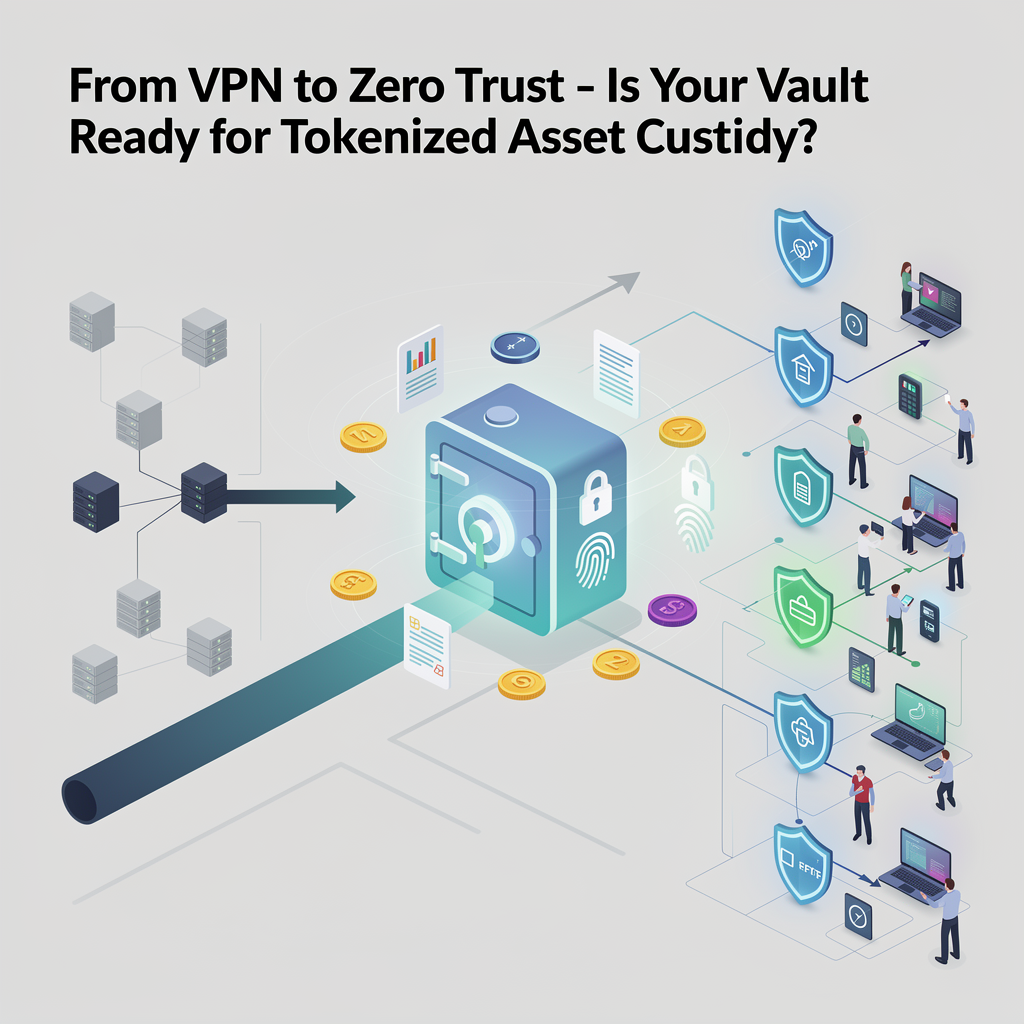
The morning I watched a security engineer argue over a VPN certificate while the vault console hummed with real-time settlements, I sensed a hinge moment in custody thinking. It wasn’t about certificates or tunnels alone; it was about whether the way we connect to custody infrastructure can keep pace with assets that settle in real time across cross‑chain rails. If tokenized RWAs are moving from pilots into core market infrastructure, then the trust we build today must survive not just one attack, but a cascade of evolving risks across partners, networks, and regulators. This conclusion is not a final verdict; it’s a reminder that the strongest protection in this age is a posture, not a tunnel.
What this means in practice goes beyond a single technology choice. The industry is inching toward continuous trust: identity verified, context aware, and granted exactly what is needed for a given action, for a precise moment in time. We’ve seen real-world signals of this shift already— tokenized real-time collateral management demonstrated by DTCC points to scalable, auditable infrastructure; MiCA regulation in Europe nudges institutions toward licensed custody ecosystems; and banks are expanding custody capabilities to cover tokenized assets with insured storage rigs. Taken together, these trends push custody architectures toward interoperability and verifiable governance rather than isolated safeguards.
Key takeaways from this turning point:
– VPNs are useful as part of a layered defense, but they cannot stand alone in an environment where assets move in real time and across multiple networks. The model must evolve toward zero trust and continuous verification.
– The security stack increasingly combines MPC wallets, cross-chain vaults, insured storage, and WaaS with automated compliance to create a cohesive, auditable pipeline for tokenized assets.
– Regulatory expectations are shaping design choices: licenses, segregated client assets, and mature cyber risk programs are the baseline, while governance and attestations prove ongoing reliability.
Action plans you can deploy now
1) Map access pathways: identify every vault console, settlement node, and data room that touches tokenized assets. For each path, document who needs access, what they need to do, and under what conditions.
2) Transition to context-based, just-in-time access: implement a zero-trust model with device posture checks, multi-signal authentication, and dynamic authorization that can be tightened or revoked in real time.
3) Embrace modular security primitives: articulate how MPC wallets, seedless onboarding, cross-chain vaults, and insured storage fit your assets’ risk profile and regulatory footprint.
4) Build an auditable governance narrative: publish regular attestations, third-party audits, and clear incident response playbooks that regulators and counterparties can review without bespoke translation.
5) Align incentives with regulators: design controls and reporting that satisfy MiCA, SEC guidance, and cross-border requirements so that your custody posture is demonstrably compliant under real market conditions.
A closing reflection and a question to carry forward
As tokenized assets embed themselves in regulated infrastructures, the bar for secure remote access rises with them. The question before us is not simply whether VPNs can be replaced, but whether we can prove trust continuously to auditors, clients, and regulators alike. Will you pursue a pragmatic hybrid approach that blends VPN with context-rich zero-trust controls, or commit to a full zero-trust posture across custody operations? The answer you choose will shape not only your security posture but the perceived reliability of your entire custody program in a market that demands auditable, interoperable, and insured assurances.
So, what steps will you take this quarter to move toward continuous trust in custody access? Which combination of MPC, WaaS, cross-chain vaults, and insured storage best fits your asset mix and regulatory footprint? If this perspective resonates, start the mapping and the risk-based redesign today—and invite regulators and partners to review your journey, not just your outcomes.