I still remember the moment when a bridge transfer on a testnet hiccuped and spiraled into silence—the kind of pause that makes you rethink where trust really lives in a multi-chain world. It wasn’t a flashy exploit, just a quiet misstep in verification, a nonce that didn’t quite line up, and suddenly the promise of seamless cross-chain liquidity looked a little more fragile. If you’re building or defending Solana bridges, you’ve probably felt that tension too: the desire for fast, interconnected systems colliding with the stubborn realities of cryptographic custody, oracle correctness, and state verification. So what does it take to move from hopeful architecture to durable security? Let’s walk through a concrete, six-week plan that blends current industry developments with pragmatic engineering practices.
What’s at stake in Solana cross-chain bridges goes beyond a single protocol or a single incident. It’s about how many guardrails we’re willing to trust when transmitting value across ecosystems: guardians, validators, oracles, verification layers, and governance itself. Recent developments reveal a landscape that’s shifting toward fewer single points of failure and more robust, auditable routes for crossing state and assets. For example, major bridge ecosystems have been deprecating older rails and strengthening front-end and guardian arrangements, with phased timelines aimed at reducing risk while preserving inbound transfers during transitions. These shifts are documented in 2025 updates about network deprecations, guardian security enhancements, and evolving incentive models that fund security and governance more sustainably. See: ongoing Wormhole network deprecations and Guardian Network upgrades, including collaborations with Google Cloud to bolster uptime; the W token 2.0 upgrade aligning incentives with security; and notable research toward privacy-preserving cross-chain interactions (for instance, ZK coprocessor concepts and verifiable cross-chain architectures). You can explore those updates here and here, and you’ll notice a clear trend toward more resilient, verifiable cross-chain connections.

Is it possible to design a bridge that feels almost edge-proof while remaining flexible enough to adapt as ecosystems evolve? The answer is yes, if we architect for verification, transparency, and rapid patching from day one. In practice, that means embracing non-custodial, trust-minimized approaches where feasible; adopting lightweight client verification or zero-knowledge-based verification to reduce reliance on centralized guards; building rigorous governance and patch-management practices; and ensuring that privacy features do not outpace accountability unless we have robust auditability baked in from the start. Recent research and industry activity point in that direction. For instance, ZK-based cross-chain ideas and related coprocessor concepts are moving toward replay-safe private execution and cross-domain verification, while independent tools and analysis (like ConneX) push for auditable cross-chain transaction mappings. These threads are not merely theoretical: they are shaping practical strategies for safer interoperability across Solana, Ethereum, and beyond.
Two quick-context notes you’ll find useful as you plan: first, the landscape is actively evolving. Wormhole has announced deprecation plans for several chains, along with inbound/outbound messaging changes and frontend transitions, with Summer 2025 targeted for major phases and full deprecation on some rails. Guardian networks have been strengthened with cloud-backed redundancy to improve verification reliability. Second, researchers and practitioners are turning to more transparent, verifiable cross-chain schemes—zk-based proofs, lightweight verification, and post-incident analyses that feed bug bounties and rapid patching. This isn’t just about preventing exploits; it’s about making cross-chain activity more auditable and traceable for teams like yours. For primary references, see the latest Wormhole updates and industry analyses cited below.
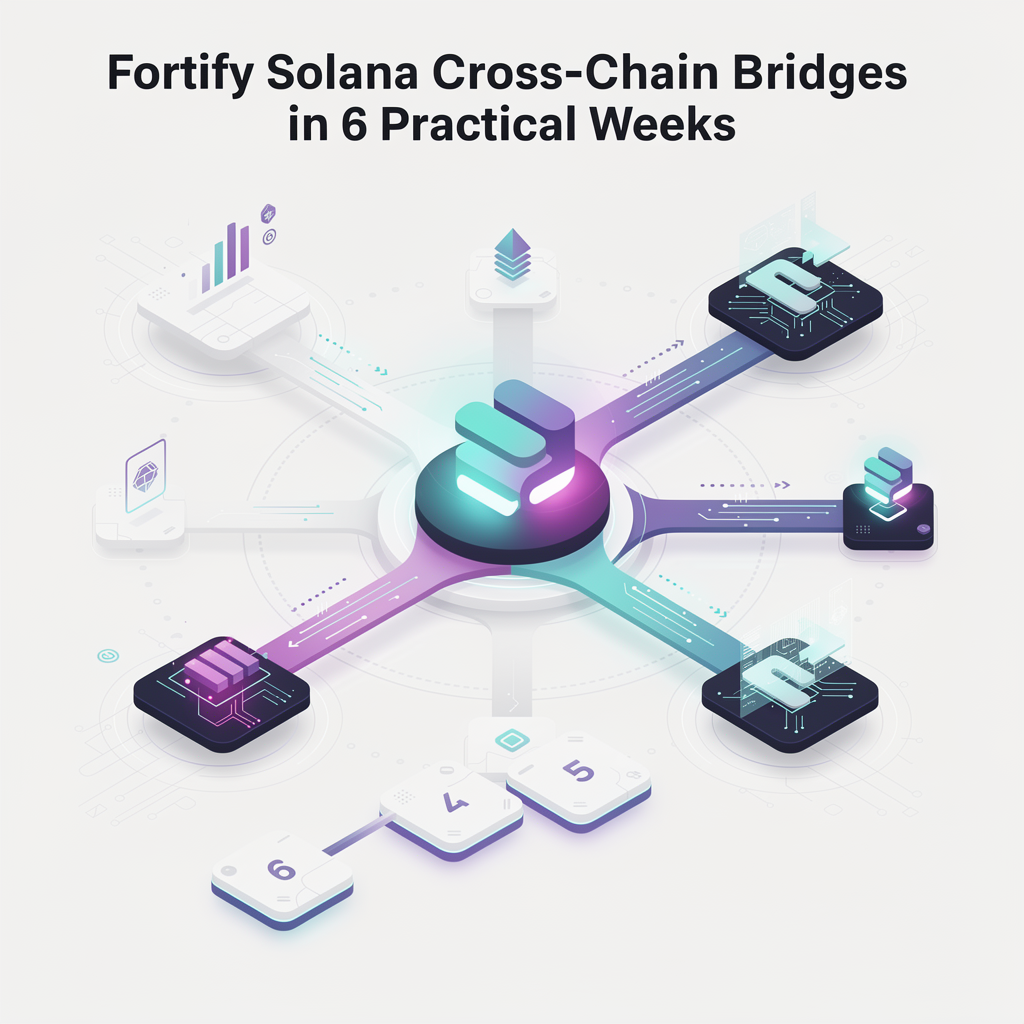
What follows is a practical, six-week plan you can adapt to your team’s size, risk posture, and deployment cadence. It’s designed to be implementable while still aligning with current developments in the Solana ecosystem and cross-chain research.
Week 1–2: Harden the guardrails and increase transparency
– Audit and rotate guard/guardian processes: move toward larger, rotating guardian sets with clearer threshold signatures to reduce single-point risk. Review whether your current guardian approach remains compatible with future zk-ready paths and multi-sig thresholds as outlined in recent network updates.
– Establish end-to-end state verification as a core requirement: ensure every cross-chain transfer is verified by a robust, least-trust model—preferably with light clients or zk-based verification where feasible. Begin evaluating a zk Coprocessor Bridge concept as a long-term target (Solana → Aztec via verified VAAs) to minimize reliance on centralized state assertions. (References: 2025 security and research updates; ZK-based cross-chain concepts)
– Tighten nonce, replay, and signature hygiene: implement strict replay protection, unique nonces per transfer, and robust signature validation across all participating chains. Plan tests and audits focused on these vectors.
– Initiate formal security governance: publish an internal patching playbook, establish a rapid-response bug bounty workflow, and align rewards with security milestones. (Guidance inspired by ongoing security analyses and governance alignment efforts)
Week 3–4: Integrate auditable verification and privacy controls
– Adopt an optional privacy-preserving mode with accountable auditing: if you implement confidential transfers, pair them with verifiable logging and external audits. Balance privacy with traceability to support forensic analysis without compromising user confidentiality.
– Pilot non-custodial and trust-minimized flows: if your bridge currently relies on centralized controls, pilot a non-custodial approach for a subset of transfers, using rotating signer models and ready-made verifier modules.
– Deep dive risk education for the team: align engineering, product, and security teams around common threat models and acceptance criteria for new verification layers. Share summaries of recent research, including privacy-preserving and verifiable cross-chain approaches. (Cited materials reflect the current direction in cross-chain research and practice)
Week 5–6: Field test, patch, and document
– Run a limited, controlled cross-chain test with upgraded verifier logic and patched guard rails: monitor for anomalies, nonce reuse, or unexpected re-validation events, and collect telemetry for post-incident analysis.
– Formalize patch-management and release governance: ensure every upgrade undergoes rapid, multi-party review and has clear rollback procedures. Tie governance changes to tokenomics signals that incentivize ongoing security investment (e.g., token upgrade programs like W token 2.0).
– Publish a transparent post-mortem-oriented report: even if no incident occurs, document the test results, decisions, and remaining watchpoints to improve external trust and internal learning. References to ongoing post-incident analyses and audits show how this practice supports continuous improvement.
Bringing it together: why this approach matters now
– The security of cross-chain bridges is not a one-off engineering problem; it is an ongoing program of verified state, resilient architecture, and accountable governance. The latest ecosystem activity—ranging from Guardian network upgrades to zk-based cross-chain inquiry—points toward a more auditable, resilient future for Solana bridges. For example, recent updates describe network deprecations and front-end transitions, Guardian network reinforcement through cloud-backed reliability partnerships, and the ongoing push toward privacy-preserving yet verifiable cross-chain interactions. See Wormhole’s 2025 updates and related research discussions for detailed context, along with the emerging ConneX tooling aimed at mapping cross-chain transactions for forensics and analytics. These materials provide a backdrop for the concrete steps above and help you calibrate your risk tolerance and roadmap. Citations: Wormhole updates on supported networks and Guardian security enhancements; the W-token 2.0 upgrade; ZK Coprocessor Bridge concepts; ConneX cross-chain transaction mapping.
A few practical sources and angles worth bookmarking as you work:
– Wormhole network updates and front-end deprecations with Summer 2025 timelines and inbound/outbound messaging distinctions. These notes emphasize phased shutdowns and governance-driven safety margins. (Source: Wormhole updates)
– Guardian network expansions and cloud-backed verification enhancements (e.g., Google Cloud collaboration) that strengthen uptime and defense-in-depth. (Source: Wormhole announcements)
– Privacy-preserving and verifiable cross-chain research, including ZK Coprocessor Bridge concepts and related verifications, which illustrate the trajectory toward more auditable cross-chain interactions. (Sources: arXiv papers and related technical writeups)
– Independent security analyses and governance- and patch-oriented literature that inform best practices for ongoing risk management in bridges. (Sources: CertiK analyses and similar security reports)
As you start to map these ideas onto your project, I invite you to consider: where is your weakest link today—guardians, state verification, or patch governance—and what single change would most meaningfully increase your security posture this quarter? If you could run a six-week sprint focused on one high-leverage improvement, what would it be—and who would you bring in to own it? Wouldn’t it be worth testing a zk-assisted verifier in a controlled pilot to see whether trust can be reduced without compromising accountability?
Should a Solana Bridge Be Edge-Proof? A Six-Week Plan for Safer Cross-Chain Interoperability
I remember the moment like a quiet alarm in bright debugging light: a testnet transfer stalls mid-journey, a nonce misalignment wanders into an unchecked state, and suddenly the promise of seamless cross-chain liquidity feels… fragile. It wasn’t a flashy hack, just a small misstep in verification that ripples into a larger question: where does trust live when state moves across ecosystems? If you’re building or defending Solana bridges, you’ve probably felt that tension too. The urge for fast, interconnected systems collides with the stubborn realities of cryptographic custody, oracle correctness, and state verification. This piece isn’t a final blueprint so much as a shared exploration of a durable path forward—one that begins with a concrete plan you can actually try this quarter.
What’s at stake goes beyond a single protocol or a single incident. It’s about how many guardrails we’re willing to trust as assets travel between Solana, Ethereum, and the many other ecosystems. Guardians, validators, oracles, verification layers, and governance itself—each represents a hinge on which cross-chain trust can swing. The landscape in 2025 paints a clear trend: deprecating older rails, strengthening guardian architectures, and pushing verification toward transparent, verifiable models that are harder to game. Those shifts aren’t cosmetic; they’re about resilience.
Key scenes from the year help us sketch the arc. Wormhole’s network deprecations and phased front-end changes signal a migration toward leaner, more auditable cross-chain rails, with inbound transfers still allowed under guardian thresholds during phased transitions. Guardian networks have grown more robust, aided by cloud-backed redundancy partnerships with providers like Google Cloud to improve uptime and defense-in-depth. On the economic side, tokenomics upgrades (like the W token 2.0) aim to stabilize security funding and governance participation as the ecosystem scales. And researchers are pushing privacy-preserving, verifiable cross-chain interactions—zk-based approaches and coprocessor concepts that strive for replay-safe private execution across domains. These threads aren’t merely academic; they’re shaping practical strategies you can apply today. See: updates from Wormhole, ZK coprocessor concepts, and ConneX-style transaction mapping for forensics.
With that context in mind, here’s a six-week plan designed for engineering teams—whether you’re a CTO, a security lead, or a hands-on engineer—who want to move from hopeful architecture to durable security. It’s anchored in current developments but crafted to be adaptable to your team’s size and risk posture. The goal is not perfection at launch but a clear, auditable trajectory toward fewer single points of failure and more resilient cross-chain state.
Week 1–2: Harden the guardrails and increase transparency
– Audit, rotate, and broaden guard sets: shift toward larger, rotating guardian groups with clearer threshold signatures. Evaluate how this evolves toward zk-ready paths and multi-sig thresholds as described in 2025 ecosystem updates. The aim is to reduce single-point risk without sacrificing timeliness of verification.
– Make end-to-end state verification a core requirement: move toward light-client verification or zk-based verification for cross-chain transfers. Begin outlining a long-term target like a zk Coprocessor Bridge concept (Solana → Aztec via verified VAAs) to minimize reliance on centralized state assertions.
– Tighten nonce, replay, and signature hygiene: implement strict replay protection, per-transfer nonces, and robust signature validation across all participating chains. Design tests and audits that specifically exercise these vectors.
– Initiate governance for security responses: publish an internal patching playbook, establish a rapid-bounty workflow, and align rewards with security milestones. This is about making patching an ongoing program, not a one-off event.
Week 3–4: Integrate auditable verification and privacy controls
– Introduce optional privacy with accountable auditing: if confidential transfers are used, pair them with verifiable logging and independent audits. Keep privacy but ensure traceability to support forensic analysis without eroding user confidentiality.
– Pilot non-custodial, trust-minimized flows: if your current bridge leans on centralized controls, pilot a non-custodial path for a subset of transfers using rotating signers and verifier modules. Measure latency, risk, and user experience.
– Deep-dive risk education across teams: align engineering, product, and security around shared threat models and acceptance criteria for new verification layers. Share concise summaries of privacy-preserving and verifiable cross-chain approaches to build a common mental model.
Week 5–6: Field test, patch, and document
– Run a controlled cross-chain test with upgraded verifier logic and patched guard rails: monitor for nonce reuse, re-validation anomalies, and other unexpected state transitions. Collect telemetry for post-incident analysis, even if nothing goes wrong.
– Formalize patch-management and release governance: ensure upgrades go through multi-party review, with clear rollback procedures. Tie governance changes to tokenomics signals that incentivize ongoing security investment (e.g., token upgrade programs similar to W token 2.0).
– Publish a transparent post-mortem-oriented report: even in the absence of an incident, document test results, decisions, and remaining watchpoints. External trust grows through openness and continuous learning.
Bringing it together: why this approach matters now
The security of cross-chain bridges is not a one-off engineering problem; it’s an ongoing program of verified state, resilient architecture, and accountable governance. The latest ecosystem activity—Guardian network upgrades, targeted deprecations, zk-based cross-chain inquiry, and auditable cross-chain transaction mappings—points toward a future where cross-chain activity is more auditable, verifiable, and resilient. Industry updates and research show a converging trend toward non-custodial, trust-minimized architectures, lightweight or zk-based verification, and stronger patch governance that keeps pace with rapid ecosystem changes.
Practical sources and angles worth bookmarking as you work:
– Wormhole updates on supported networks, guardian security enhancements, and deprecation timelines (2025).
– Guardian network expansions, including cloud-backed verification improvements (e.g., Google Cloud collaboration).
– Privacy-preserving and verifiable cross-chain research, including ZK Coprocessor Bridge concepts, which illustrate a trajectory toward auditable cross-chain interactions.
– Independent security analyses and governance/patch-oriented literature guiding best practices for bridges (e.g., post-incident analyses and bug-bounty-informed improvements).
As you map these ideas to your project, ask yourself:
– Where is your weakest link today—guardians, state verification, or patch governance?
– What single change would most meaningfully increase your security posture this quarter?
– If you could run a six-week sprint focused on one high-leverage improvement, what would it be—and who would you bring in to own it?
– Wouldn’t it be worth testing a zk-assisted verifier in a controlled pilot to see whether trust can be reduced without compromising accountability?
Try this directly now: a practical starter kit
– Inventory and rotate guardians: document current guardian composition, rotation schedule, and threshold math. Plan a staged rotation with an external auditor participating in the first round.
– Implement replay protection: add per-transfer nonces, a centralized nonce registry (with cross-chain synchronization), and deterministic replay checks across all involved chains.
– Draft a patch governance playbook: outline roles, approvals, testing gates, and rollback steps. Tie a quarterly security incentive to tokenomics signals.
– Start a lightweight verifier test on a testnet: deploy a minimal light-client verifier in parallel with your existing checks, measuring latency, false positives, and coverage.
– Explore a pilot zk-assisted verifier: design a small, contained experiment to test replay-safe private execution with verifiable VAAs, documenting the outcomes and learnings.
– Build a privacy-visibility balance: create an opt-in privacy mode that logs verifiable proofs with external audits, ensuring accountability without leaking sensitive data.
– Map cross-chain flows forensics: pilot a ConneX-like mapping approach to improve traceability of cross-chain transactions, making anomalies easier to investigate.
– Document the journey: publish a small, transparent post-mortem-oriented report after the test, including decisions and observed gaps, to build external trust and internal learning.
If you want a mental model for ongoing work, picture a bridge not as a single code path but as a living program: verification is continuously strengthened, guard rails are renewed, and governance and patching are treated as part of the product you ship, not a back-office concern. The newest ecosystem signals—zk verification, larger rotating guardians, auditable cross-chain mappings—are not speculative futures; they’re becoming practical tools you can deploy now to reduce risk and increase resilience.
Would you rather chase a perfect future or start building toward a safer, verifiable present? The six-week sprint above is designed to help you begin the journey today, with measurable milestones and options you can adapt to your team. And if you’re wondering where to begin, the first concrete move is often the simplest: widen the guardian base and lock in replay-resistant state verification. From there, you can layer privacy with accountability, and governance with patch discipline, until cross-chain transfers feel as trustworthy as the native experience you’re trying to replicate.
Key themes in this space—Solana cross-chain bridges: security risks and mitigation strategies—will continue to evolve as research, industry tooling, and governance practices mature. Keeping a steady cadence of tests, audits, and transparent reporting will help you stay ahead of the curve while you ship safer, more auditable bridges for users and partners alike. If you’d like, I can tailor this six-week plan to your team size, risk posture, and deployment cadence, and help convert it into a runnable project plan with milestones and owners.
Building Durable Trust Across Chains: A Concluding Note
That testnet stall was not a dramatic hack; it was a quiet alarm about where trust really lives when state moves across ecosystems. It reminds us that security in cross-chain bridges is less a single feature and more a continuous practice—verification, governance, and openness must evolve together. If you’re building or defending Solana bridges, you’re not chasing a final blueprint so much as nurturing a living system that gets stronger as you learn and adapt.
Key takeaways and implications
- End-to-end verification must be the default. Lightweight, transparent state verification (via light clients or zk-based approaches) reduces reliance on any single guardrail and makes cross-chain transitions auditable from end to end.
- Guardrails are a living architecture. Broad, rotating guardian sets and clearly defined threshold signatures help disarm single points of failure while staying adaptable to zk-ready paths as the ecosystem evolves.
- Privacy and accountability can coexist. Optional privacy modes should be paired with verifiable logs and independent audits so forensics remain possible without sacrificing user confidentiality.
- Security is a product, not a one-off release. Formalized patch-management, rapid-bounty workflows, and governance-aligned incentives turn security from a realm of surprises into a repeatable capability.
- The broader industry is moving toward verifiable cross-chain interactions. zk-based proofs, lightweight verification, and auditable cross-chain mappings are shaping practical, auditable interoperability across Solana, Ethereum, and beyond.
- The ecosystem is dynamic. Updates from major networks (including deprecations, guardian enhancements, and incentive model shifts) signal a shift toward fewer failure points and more resilient, observable bridges.
Action Plans
- Starter kit for immediate hardening: inventory and rotate guard sets now, document rotation schedules, and designate an owner for ongoing oversight.
- Establish end-to-end verification as a baseline: outline a practical target for lightweight or zk-based verification and begin a pilot path toward a zk Coprocessor Bridge concept.
- Harden state hygiene: implement per-transfer nonces, robust replay protection, and cross-chain signature hygiene; design tests focused on these vectors.
- Governance as a continuous discipline: publish a patching playbook, set up rapid-bounty workflows, and align rewards with security milestones.
- Pilot non-custodial flows: experiment with rotating signers and verifier modules on a subset of transfers to measure latency, risk, and UX impact.
- Field-test and document: run controlled tests with upgraded verifier logic, collect telemetry, and publish a transparent post-mortem-oriented report—even if no incidents occur.
Closing message
The journey to safer cross-chain interoperability isn’t about chasing a perfect future; it’s about building a safer present through disciplined practice. Each improvement—more transparent verification, broader guardrails, stronger patch governance—reduces risk and builds trust with users and partners alike. As you map these ideas to your project, ask yourself:
– Where is your weakest link today—guardians, state verification, or patch governance?
– What single change would most meaningfully increase your security posture this quarter?
– If you could run a six-week sprint on one high-leverage improvement, what would it be—and who would you bring in to own it?
– Could a zk-assisted verifier pilot reduce trust requirements without compromising accountability?
If you’d like, I can tailor this six-week pathway into a runnable project plan with milestones and owners suited to your team size, risk posture, and cadence. Start with a concrete next step today—perhaps widening the guardian base and locking in replay-resistant state verification—and you’ll already be moving toward a safer, more auditable bridge for users and partners alike.