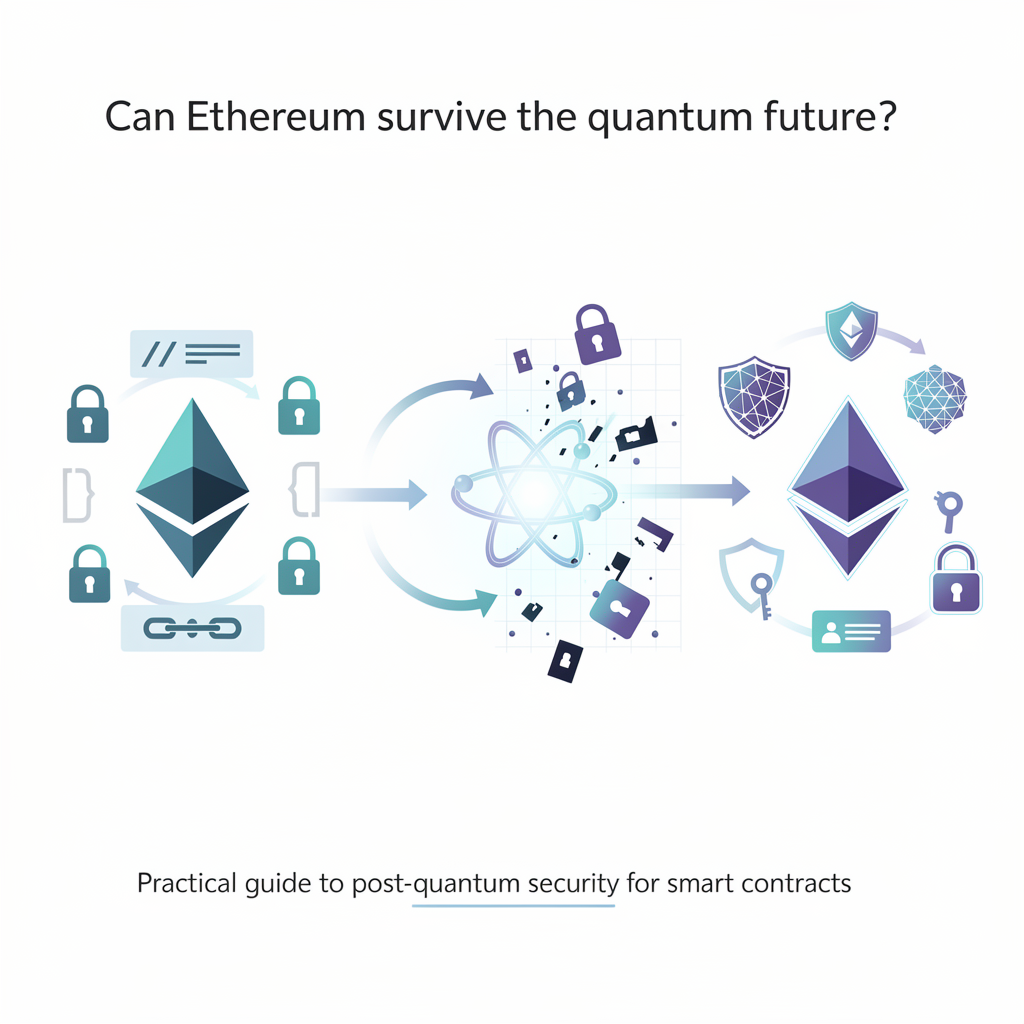
Can Ethereum Survive the Quantum Future? A Practical Guide to Post-Quantum Security for Smart Contracts


I once watched a small team ship a smart contract that relied on the whisper-quiet security of ECC keys, only to realize two years later that a quantum reality could render those protections obsolete in a single stroke. The moment wasn’t dramatic in the lab. It was ordinary—code pushed, gas paid, users reading headlines about hacks and forks—but it carried a quiet question: what if today’s security is tomorrow’s liability?
That question isn’t a theoretical luxury. It’s becoming a governance and engineering principle for Ethereum as the cryptographic landscape starts to sprout new, quantum-resistant options. In recent years, standard-setters at NIST have finalized several post-quantum building blocks, and the ecosystem is exploring pragmatic paths to adopt them without collapsing into a thousand forks or a surge of gas costs. Recent developments show a real, near-term horizon for usable PQC on-chain and in wallets. For anyone building on Ethereum, the path is not about instant replacement but about crypto‑agility—designing systems that can evolve their cryptographic primitives over time without breaking the chain.


What’s changing for Ethereum cryptography? At the heart of it is a shift from ECDSA over secp256k1 to post-quantum signatures and secure, quantum-resistant key exchange mechanisms. The current mainstream candidates come from several families: lattice-based, hash-based, and hybrid approaches. Kyber (ML-KEM) is the lattice-based key-exchange backbone that’s a leading option for long-term confidentiality and key establishment; Dilithium (ML-DSA) and Falcon (FN-DSA) are lattice-based signature schemes, while SPHINCS+ (SLH-DSA) represents a hash-based approach with very strong, different security assumptions. HQC is another candidate that joined the standardization stream in 2025, broadening the toolbox for crypto-agility. These are not “replacements” you flip on overnight; they’re building blocks for a phased migration. (NIST standards finalized in 2024; HQC added in 2025; see nist.gov for details.)
How practical is it to deploy PQC in Ethereum today? The main constraint is on-chain verification cost. PQC signatures and keys are larger than ECDSA, which translates to higher gas for on-chain verification unless we rework how we verify and where we verify. That’s precisely why researchers and ecosystem projects are focusing on verification efficiency and wallet-level crypto‑agility as a stepping-stone. Projects like ZKnox, backed by the Ethereum Foundation, are actively exploring practical PQC verification optimizations and on-chain verification techniques that aim to preserve usability while expanding security options. Early reports suggest gas costs for lattice-based verification can be kept within reasonable bounds with specialized verification schemes and off-chain computation where appropriate. (The Block coverage; on-chain verification work presented in 2025 papers.)
A practical migration happens in layers. Account Abstraction (ERC-4337) is a natural bridge: it allows wallets and smart contracts to experiment with alternative verification logic without forcing a hard change to the consensus layer. In other words, you can adopt a PQC-like wallet or verifier today and keep the base protocol stable while you test end-to-end flows. The governance studies within the Ethereum community consistently emphasize crypto‑agility as essential: the ability to upgrade cryptographic primitives via EIPs and to run PQC-capable verifiers alongside legacy ECC during a staged transition. (EIPs 4337, industry discussions at crypto.ethereum.org.)
If you’re planning a migration, here’s the arc you can start with today, as a practical, developer-friendly path:
- Inventory and classify assets: list all accounts, multisig wallets, and smart contracts that rely on ECDSA. Identify where long-term security matters most—decentralized finance keys, governance wallets, and user-facing accounts with high value.
- Introduce crypto‑agile wallets and verifiers: through account abstraction, start testing PQC-capable verification paths in wallets and in smart contracts that rely on external verifiers. This lets you swap verification logic gradually without touching the core consensus layer.
- Build layered verification: use on-chain verifiers for critical paths and maintain off-chain helpers that validate signatures during transaction construction. This is a practical way to validate PQC flows before any mainnet upgrade.
- Choose the right PQC mix for your risk profile: lattice-based schemes like Kyber and Dilithium offer mature tooling; SPHINCS+ adds a robust alternative with its hash-based security model; HQC provides a diversification option. Remember, your choice affects key sizes, verification costs, and upgrade paths. (NIST standardization updates; 2024 finalization and 2025 additions.)
- Test, simulate, and stage: run pilot networks that use PQC verifiers, measure gas and latency, and iterate on parameters. The goal is to prove that the PQC path improves security with manageable cost, not to create a block’s worth of risk every time you verify a signature.
- Establish governance and upgrade plans: ensure your roadmap aligns with Ethereum’s crypto‑agility discussions. Plan how a future hard upgrade or an EIP-driven change would roll in PQC primitives without fracturing users or losing keys.
There are several tangible signals that we’re moving from theory toward production-ready PQC on Ethereum. ZKnox and related on-chain verification research show potential for practical, gas-conscious PQC verification optimizations. In parallel, the standards work around NIST PQC and ongoing community governance work illustrate a reproducible, staged methodology rather than a sudden shift. These are not just academic notes; they are a toolkit for teams building real apps that must survive a quantum era. (Sources: NIST PQC finalization and updates; The Block reporting on ZKnox; IACR and related on-chain verification papers.)
So, what’s the takeaway? The quantum future doesn’t force a single leap; it invites a disciplined, incremental upgrade path that honors the codebase you’ve shipped, the users who rely on it, and the gas constraints that keep the network usable. The question isn’t whether to migrate, but when and how to orchestrate a staged, crypto‑agile transition that scales with your risk tolerance and development velocity.
Are you ready to start experimenting with crypto‑agility in your smart contracts today, while planning a longer, robust migration to full post-quantum security tomorrow? If we commit to a layered approach—wallets first, verifiers next, governance last—we can build Ethereum’s resilience without sacrificing user experience.
Notes and sources you may find useful as you dive deeper:
– NIST’s finalized post-quantum standards (Kyber, Dilithium, SPHINCS+) and the later selection of HQC as a backup option. These provide concrete parameterizations for practical deployment. [nist.gov]
– Ethereum-specific PQC research streams (ZKnox and on-chain verification efficiency) showing progress toward feasible on-chain verification and gas-conscious design. [theblock.co], [eprint.iacr.org]
– Ethereum’s crypto-agility discussions and the role of Account Abstraction (ERC-4337) as a bridge to post-quantum verification paths. [crypto.ethereum.org], [eips.ethereum.org]
If you’d like, I can tailor a 4-week onboarding plan for your project, mapping out concrete milestones, cost estimates, and a testnet rollout scenario.
Should Ethereum go post-quantum, or is today the day we start testing the future?
I remember pushing a small wallet upgrade that added a new signature check. It felt procedural: new code, new tests, new gas estimates. Then, a late-night conversation with a teammate about the long arc of crypto security. We were careful not to overpromise. We were also asking a stubborn question we couldn’t shake: what happens when today’s security becomes tomorrow’s liability? That quiet question became a small, stubborn compass for the work that followed—and it’s the same question guiding Ethereum developers today as the quantum horizon moves from rumor to reality.
What changed? In the last couple of years, cryptographers and protocol designers haven’t been trying to reinvent the wheel in a hurry. They’ve been building a toolbox of post-quantum primitives that are ready enough to consider in serious deployments, while acknowledging the costs and the migration path. The National Institute of Standards and Technology (NIST) has finalized several PQC building blocks and then expanded the set as of 2025, adding diversity to the cryptographic options we can rely on for the long term. What we’re watching isn’t a single switch flipped; it’s a staged, governance-friendly upgrade that preserves user experience while layering in quantum-resilience.
When we talk about post-quantum security for Ethereum, we’re really talking about three intertwined ideas: upgrading the cryptographic primitives used by accounts and smart contracts, enabling crypto-agility so we can swap those primitives without breaking things, and designing practical paths to verification that don’t crater gas costs. Let’s walk through these ideas, tell a story from the trenches, and map a slice of reality onto a plan you can start testing today.
Why this matters now
-
What changes at the core: today’s Ethereum uses ECDSA on secp256k1 for accounts and many signatures in smart contracts. Quantum computers threaten ECDSA’s security footprint in the long run, so the ecosystem is exploring post-quantum signatures and key-exchange schemes. The PQC toolbox includes lattice-based options like Kyber (for key exchange) and Dilithium or Falcon (for signatures), as well as hash-based SPHINCS+. HQC has been added as a backup option in standardization discussions. In practical terms, this means we’re preparing for longer-lived keys and the ability to recover or maintain security even when quantum-capable adversaries appear.
-
The standards landscape is maturing: in 2024, NIST finalized a first wave of PQC standards (Kyber, Dilithium, SPHINCS+), establishing concrete parameters. In 2025, HQC was added as another standardized candidate, broadening the cryptographic palette and enabling diversification. This isn’t a speculative forecast—it’s a structured plan that many teams can begin to align with, gradually.
-
Ethereum-specific research is progressing toward practicality: a growing set of projects explores how to verify PQC on-chain with reasonable gas costs, and how wallets and verifiers can be made crypto‑agile. One notable initiative backed by the Ethereum Foundation is exploring on-chain verification optimizations for lattice-based signatures, with reporting suggesting that gas costs can be kept within workable bounds through specialized verification schemes and off-chain helpers where appropriate. Account Abstraction (ERC-4337) provides a natural bridging layer, enabling PQC logic in wallets and verifiers before any protocol-level upgrades to the consensus layer.
A practical lens: what kind of changes are we talking about?
-
Signatures and key exchange: expect larger public keys and signatures than today’s ECC-based schemes. PQC primitives bring different math to the table, which translates into bigger data published on-chain and potentially higher verification costs. That’s the core reason many teams advocate for crypto-agility and staged migrations rather than a single, protocol-wide hard fork.
-
Verification costs and architecture: gas is the compiler of security decisions on Ethereum. If a PQC verifier is expensive to run directly on-chain, you’ll see two likely patterns emerge: (1) hybrid verification schemes that group PQC checks into off-chain work that is then authenticated, and (2) edge-friendly on-chain verifiers tailored for the most critical transaction paths (e.g., governance or high-value vaults).
-
Gradual adoption route: crypto-agility is the enabling principle. Wallets and smart contracts can begin to test PQC verifications via Account Abstraction (ERC-4337), while the core consensus layer stays with the familiar ECC primitives during a cautious, governance-driven upgrade path.
A concrete, developer-friendly migration arc
If you’re building on Ethereum today and want to position your project for a quantum-era upgrade, think in layers, not leaps. Here’s a pragmatic progression that many teams can start rehearsing on testnets now:
- Inventory and classification: map every place where long-term security matters—high-value accounts, multisig configurations, governance keys, and major DeFi vaults. Note which assets would be most at risk if a signature system were compromised.
- Enable crypto-agile wallets and verifiers: use Account Abstraction to test PQC-capable verification paths. This lets you swap verification logic in a controlled environment, while your base protocol remains stable.
- Build layered verification: for critical flows, keep a model where signature validation can be done off-chain or in specialized verifiers that are then anchored by on-chain proofs. This lets you experiment with PQC flows without blowing up gas costs on every transaction.
- Choose a practical PQC mix: Kyber (for key exchange) and Dilithium or Falcon (for signatures) are the current mature lattice-based options, SPHINCS+ offers a hash-based alternative with different risk characteristics, and HQC adds diversification. The right mix depends on your risk tolerance, expected asset lifetimes, and your upgrade strategy.
- Test, measure, iterate: build pilot networks that run PQC verifiers, gather data on gas and latency, and adjust parameter choices. The aim is to demonstrate security benefits without creating new bottlenecks or reliability risks.
- Governance and upgrade planning: align with Ethereum’s crypto-agility discussions and prepare how an EIP-driven path might roll in PQC primitives without fragmenting users or requiring a disruptive fork.
What a 4-week onboarding could look like
Week 1 — Asset inventory and risk assessment
– Inventory all accounts, multisigs, and contracts relying on ECDSA.
– Classify assets by risk tier and identify exfiltration surfaces (e.g., governance keys, high-value DeFi positions).
– Define success metrics for a PQC pilot (gas, latency, security margins, user impact).
Week 2 — Foundations for crypto-agility
– Introduce PQC-capable wallets or verifiers via Account Abstraction in a testnet setting.
– Establish a small verifier module that can validate a PQC signature off-chain and provide an on-chain proof or attestation.
– Document the upgrade path and governance requirements needed to move from testnet to mainnet.
Week 3 — Layered verification experiments
– Implement a staged verification flow for critical paths, combining on-chain verifiers with off-chain validation steps.
– Measure protocol impact: gas costs, block times, and latency for typical user actions (transfer, governance vote, contract interaction).
– Explore multiple PQC options in parallel to compare performance and security trade-offs.
Week 4 — Governance, tooling, and rollout plan
– Prepare a pilot deployment plan with clearly defined milestones and rollback capabilities.
– Draft an EIP-style governance note describing the chosen PQC approach, verifier architecture, and upgrade path.
– Create a user communications plan to explain why and how the upgrade will occur, minimizing user friction.
A practical, high-signal takeaway
- Start with crypto-agility at wallet and verifier level before any protocol-wide changes. A layered, testnet-first approach helps you validate that PQC flows deliver real security gains without compromising usability or participation.
- Diversify the PQC toolkit to avoid over-reliance on a single primitive. Kyber for key exchange, Dilithium/Falcon for signatures, SPHINCS+ for hash-based security, and HQC as a backup strategy give you resilience against some future cryptanalytic surprises.
- Build governance into the migration plan early. The best paths are those that ride the wave of Ethereum’s own crypto-agility conversations rather than fighting the current.
A note on realism and timelines
The work is ongoing, and the most credible paths emphasize gradual, governance-friendly upgrades rather than catastrophic forks. We’re already seeing dedicated research into practical on-chain verification efficiencies, crypto‑agile wallet designs, and staged upgrade patterns that avoid user disruption. The aim isn’t to hasten a leap into a quantum future but to cultivate a reliable, auditable, and usable transition path that can scale with your risk appetite and development velocity.
What do you think is the right balance for your project: quick wins in wallet-level PQC tests, or a long-running, server-to-EVM migration plan that emphasizes verification efficiency? Could you start a small pilot on a testnet this week and share the data with your dev team and stakeholders? If we pursue a layered, experimental approach—wallets first, verifiers next, governance last—we can build Ethereum’s resilience without sacrificing the user experience.
Notes and sources you may find useful as you dive deeper:
– NIST PQC finalization and ongoing expansions (Kyber, Dilithium, SPHINCS+, HQC): nist.gov and csrc.nist.gov
– Ethereum-focused PQC experiments and news (ZKnox, on-chain verification): theblock.co, eprint.iacr.org
– Ethereum’s crypto-agility discussions and Account Abstraction as a bridge (ERC-4337): crypto.ethereum.org, eips.ethereum.org
If you’d like, I can tailor a 4-week onboarding plan for your project, mapping concrete milestones, cost estimates, and a testnet rollout scenario. The quantum horizon isn’t somewhere we need to fear; it’s a coordinate for a deliberate, staged evolution of security that respects the work you’ve already shipped and the users who rely on it.
Key Summary and Implications
Over the course of this discussion, we’ve sketched a practical, staged path to post-quantum security on Ethereum that centers on crypto‑agility and layered verification. The core takeaway is not a single upgrade, but a disciplined evolution: start with wallet verifiers, test PQC in controlled environments, and align governance so new primitives can be swapped in without breaking users or breaking the chain’s stability. The PQC toolbox—Kyber for key exchange, Dilithium/Falcon for signatures, SPHINCS+ for hash-based resilience, with HQC as a diversification option—offers a palette you can mix and match rather than a one‑size‑fits‑all replacement. This staged, governance‑driven approach preserves usability while expanding long‑term security.
A few fresh implications stand out. First, the migration becomes as much about organizational readiness as cryptography: asset inventories, risk classifications, and clear upgrade plans are as critical as the math. Second, crypto‑agility requires ecosystem coordination—wallets, verifiers, and governance engines must move in tandem to avoid fragmented user experiences. Third, diversification across PQC families helps hedge against future cryptanalytic surprises, while layered verification keeps on‑chain costs in check by pushing heavier work off-chain where possible. And finally, Account Abstraction emerges as a pivotal bridge, enabling real-world experimentation today without forcing protocol‑level upheaval.
With these ideas in view, the path forward is not merely technical; it’s a practice of thoughtful governance and adaptive design that can scale with risk tolerance and development velocity. The horizon isn’t a cliff to leap from, but a coastline we steadily redraw as cryptography, tooling, and community governance evolve together.
Action Plans
Week 1 — Asset inventory and risk assessment
- Map all accounts, multisigs, and contracts that rely on ECDSA.
- Classify assets by risk tier (high-value governance, DeFi keys, user-critical wallets).
- Define success metrics for a PQC pilot (gas/latency targets, failure modes, user impact thresholds).
- Form a small, cross‑disciplinary PQC working group to own the pilot.
Week 2 — Foundations for crypto‑agility
- Introduce PQC-capable wallets or verifiers via Account Abstraction (testnet) to validate alternate verification paths.
- Develop a verifier module that can validate a PQC signature off-chain and attest on-chain where needed.
- Document upgrade paths and governance requirements to move from testnet to mainnet with minimal disruption.
Week 3 — Layered verification experiments
- Implement staged verification for critical paths, combining on-chain verifiers with off-chain validation steps.
- Measure protocol impact (gas, latency, block times) for typical actions and adjust parameters.
- Run parallel experiments with multiple PQC options (Kyber/Dilithium, SPHINCS+, HQC) to compare trade-offs.
Week 4 — Governance, tooling, and rollout plan
- Draft an EIP‑style governance note detailing the chosen PQC approach, verifier architecture, and upgrade path.
- Create a user communications plan to minimize friction during any future rollout.
- Define rollback capabilities and monitoring dashboards for post‑deployment security and performance.
Ongoing considerations
- Start with crypto‑agility at wallet/verifier level before protocol‑wide changes.
- Diversify the PQC toolkit to reduce single‑point risk and enable phased migration.
- Align with Ethereum’s crypto‑agility discussions to ensure governance support and smooth upgrades.
Closing Message
The quantum horizon invites a measured, courageous pragmatism. You don’t have to abandon today’s security to prepare for tomorrow’s—what you can do is lay the groundwork for a secure, adaptable ecosystem. Start small, measure honestly, and let governance guide the pace. If we commit to a layered, testnet‑first approach—wallets first, verifiers next, governance last—we can strengthen Ethereum’s resilience without sacrificing user experience.
What will you begin testing this week to move toward crypto‑agility on your project? Which asset tier feels like your strongest candidate for a pilot, and what would a successful, reversible experiment look like for you? Share your plan, gather feedback, and let the data shape your path forward.
If this resonance with your team’s priorities is clear, consider kicking off a short PQC readiness workshop and drafting a concrete 4‑week onboarding plan for your ecosystem. The journey isn’t about instant perfection; it’s about deliberate, collaborative progression toward a more quantum‑resistant Ethereum.
Notes and sources you may find useful as you dive deeper: NIST PQC finalization and ongoing expansions (Kyber, Dilithium, SPHINCS+, HQC); Ethereum‑focused PQC experiments and on‑chain verification work; Ethereum’s crypto‑agility discussions and Account Abstraction bridges (ERC‑4337).