The Digital Currency Divide – Why CBDCs vs Cryptocurrencies Will Reshape Investor Regulation


The Digital Currency Divide Why CBDCs vs Cryptocurrencies Will Reshape Investor Regulation
What if your wallet is less about what you own and more about who regulates it? As 2025 closes, the boundary between state-backed money and private digital money is being drawn in dynamic, consequential ways. A growing chorus of regulators is not just watching the market; they’re redesigning the rules of the road. And for investors, that means a new kind of awareness: the regulatory landscape is no longer a backdrop, it’s a variable that moves prices, access, and trust.


What’s shifting right now?
-
Europe’s digital euro moves from idea to design: The eurozone is pursuing a digital euro that works online and offline, with caps, free basic services, and potential fees for value-added features. Pilots could arrive in 2027, with broader deployment aimed around 2029. This isn’t a niche project; it reshapes how retail payments might coexist with private crypto in everyday life.
-
MiCA broadens the EU’s regulatory umbrella: A mature framework requires crypto service providers to register, with clear rules for asset-referenced tokens and electronic-money tokens. Transitional provisions let firms align gradually, but regulators are clear about the need for honest disclosure and compliance to avoid misleading investors.
-
The UK sets a 2027 start for crypto regulation: Expect a more formalized regime that aligns consumer protections with market integrity goals, while coordinating with a broader transatlantic view on regulation.
-
In the US, a new architecture for digital assets: The GENIUS Act, signed in 2025, creates a federal framework for stablecoins—requiring full reserves and regular disclosures, with issuers subject to banking and securities oversight. Simultaneously, executive actions are shaping a federal framework and even a potential strategic digital-asset stockpile. A joint SEC/CFTC statement clarifies that certain spot crypto products may be traded on registered venues, signaling greater regulatory clarity for investors.
-
CBDCs and global design tradeoffs: IMF and BIS analyses emphasize how CBDC design choices influence financial stability, payment resilience, and cross-border flows. Expect ongoing debates about privacy, interoperability, and remuneration as central banks test retail and wholesale models.
-
China’s cross-border digital yuan push: Beyond domestic payments, China’s initiatives aim to internationalize the e-CNY, signaling how CBDCs could shape global trade and asset flows.
Why this matters for investors now
-
Regulated venues vs. unregulated platforms: As regimes clarify what qualifies as a regulated product, where and how you trade crypto assets becomes a core part of risk. Regulators are pushing for transparency, capital requirements, and consumer protections that affect cost, accessibility, and enforcement.
-
Stablecoins under a federal lens: A formal framework around reserves, disclosures, and supervisory oversight changes the risk profile of dollars-in-digital form. Issuers must navigate a landscape that blends payments, securities, and banking rules—creating a different dynamic for yield, liquidity, and counterparty risk.
-
CBDCs as a competing layer for payments, not just a backdrop: The more sophisticated and widely adopted CBDCs become, the more they influence user behavior, settlement speeds, and the attractiveness of private digital assets. Interoperability and hold-to-use design choices will shape how much demand private crypto markets retain.
-
Cross-border considerations: National designs aren’t isolated. The interaction between regional frameworks (EU, UK, US, China) and global standards will affect capital flows, arbitrage opportunities, and the regulatory premium or discount priced into crypto assets.
How to think about this trend in your own life
-
Track regulatory trajectories, not just price charts: The next big move may come from a policy paper or a regulatory milestone rather than a price swing. Keep an eye on regulator statements, treasury and central bank communications, and cross-border policy coordination.
-
Ask where you store value: If you rely on a private crypto wallet, consider how custody, transparency, and disclosure requirements may change. If you rely on traditional banks, watch for how CBDC design could affect funding and liquidity access.
-
Evaluate stability and risk more holistically: The regulatory backdrop adds a new dimension to risk pricing. A coin with strong reserves and clear issuer oversight may be less risky than a similarly volatile asset in an opaque regulatory environment.
-
Consider participation, not just observation: Investors can engage by following regulatory guidance, choosing compliant venues, and adapting strategies as regimes evolve. The frontier is not only technology but governance.
Three practical implications for readers
1) Where you buy and store crypto assets: Look for venues with clear regulatory status and ongoing compliance programs. 2) How stablecoins are used in daily life: Expect reserve-backed products and disclosures to influence reliability and price stability. 3) How CBDCs might alter payments and liquidity: Design choices will affect how quickly and cheaply money can move, which in turn can influence the demand for private digital assets.
A closing thought to carry forward
The line between state money and private money is being redrawn. As regulators choose the map, the question for each investor becomes: what kind of navigator will you be when the terrain shifts? If the rulebook changes, will you adapt with curiosity, or cling to yesterday’s assumptions? What would your next move be if a digital euro, a GENIUS-backed stablecoin, or a cross-border CBDC altered your day-to-day financial decisions?
The Digital Currency Divide: What Happens When CBDCs and Cryptocurrencies Share the Ledger?
I’ll start with a small, almost private moment I’ve had more than once lately: I reach for my wallet to pay, and the cashier asks if I want to use a card, a phone tap, or a QR code. The options look familiar, but the rules behind them don’t. A few years ago, a private crypto wallet felt like a rebellious hedge in a volatile market. Today, the same wallet exists in a world where regulators are rewriting the rulebook, where a state-backed digital currency could sit next to my cash in the same app, and where a cross‑border CBDC might move faster than a cross-border payment used to. The boundary between state money and private money is being redrawn, and investors are asked to navigate not just prices, but governance, access, and trust.
That tension—between public money and private digital money—frames a question I keep returning to: how should an investor think about CBDCs versus cryptocurrencies when the regulatory map is being drawn in real time? The answer isn’t simply: buy crypto or buy CBDC. It’s about understanding the incentives, the guardrails, and the evolving venues for custody and settlement. It’s about how design decisions in public money could reshape demand for private money—and, in turn, how private markets adapt to a new, more formalized framework.
A landscape that’s moving from concept to practice
Regulators and central banks are not merely watching the market; they are redesigning the landscape. In Europe, the digital euro is moving from the drawing board to real design discussions—online and offline use, caps on holdings, and a plan that envisions pilots in 2027 with broader deployment around 2029. The EU’s MiCA framework has matured into a comprehensive, EU-wide regime that requires licensing for crypto assets service providers, governance for asset-referenced tokens and electronic-money tokens, and a central register. These changes matter for investors because they affect where you buy, how you store, and what protections exist if something goes wrong.
Across the Channel, the United Kingdom has signaled a 2027 start for crypto regulation, aligning with a broader, more transparent approach to market integrity and consumer protections. In parallel, the United States has moved toward a federal architecture for digital assets: the GENIUS Act creates a comprehensive framework for payment stablecoins, mandating full reserves and regular disclosures, while regulators clarify the pathways for spot crypto trading on registered venues through a joint SEC/CFTC statement. These steps don’t declare a winner between CBDCs and private cryptos, but they do establish which players and products will be treated as regulated, and which risks need disclosure and oversight.
Global institutions also weigh in. The IMF’s fintech notes and BIS discussions remind us that CBDCs come with design tradeoffs—privacy versus resilience, retail versus wholesale access, and the potential effects on financial stability and policy transmission. In practice, this means ongoing debates about how a digital euro or a digital renminbi could influence consumer behavior, bank funding, and the speed and cost of payments.
China’s push to internationalize the digital yuan with cross-border capabilities adds another layer: if a state-backed currency gains traction in cross-border flows, how does that alter the incentives for private digital assets, and how should investors adjust their risk models for currency exposure and settlement reliability?
The investor takeaways, in plain language
- CBDCs are not designed to be investment assets. They are state-backed instruments intended to improve payment efficiency, resilience, and the transmission of monetary policy. Their design choices—whether holdings earn interest, whether there are caps, and how accessible they are—can have material effects on financial stability and on how much private money banks can fund through traditional channels. In short, CBDCs can influence market dynamics without being investment products themselves.
- Private cryptocurrencies and stablecoins operate in a more varied and uneven regulatory field. The EU’s MiCA regime creates a relatively uniform, EU-wide framework for licensing and consumer protections, while the UK and US are moving toward explicit, time-bound regulatory structures. In the US, a federal framework for stablecoins with reserve requirements and clear issuer obligations is taking shape, alongside coordinated oversight of trading venues. This matters for where you trade, how you custody assets, and what risks you’re exposed to if a project fails or a regulator takes a stricter stance.
- The regulatory map is still evolving, and jurisdiction is crucial. A crypto asset that looks the same in one country can face a very different regulatory fate in another. The result is a price of admission: regulated venues and transparent reserve practices become a kind of “risk-adjusted cost” investors must consider alongside volatility, liquidity, and counterparty risk.
- CBDCs could compete with—and complement—private crypto markets. Faster settlement, interoperability across borders, and potential design features like privacy or programmable money can shift user behavior. Expect changes in the demand for certain private assets as CBDCs mature and as cross-border use cases emerge.
Practical implications you can act on today
1) Where you buy and store crypto assets matters more than ever. Seek venues with clear regulatory status, robust custody solutions, and transparent disclosure practices. Regulated venues reduce some counterparty and misrepresentation risk and provide a clearer path for compliance with cross-border rules.
2) Stablecoins are entering a different risk landscape. With federal-level guardrails in places like the United States, issuer transparency and reserve disclosures become central to risk pricing. If you use stablecoins for payments or liquidity, factor in the possibility of tighter reserve requirements, stricter disclosure regimes, and enforcement actions that could affect liquidity.
3) Track CBDC design and policy signals, not just price charts. Pay attention to central-bank communications about hold limits, interest-bearing features, privacy, and interoperability. These signals affect how convenient and attractive digital payments are, which in turn can influence demand for private digital assets.
4) Consider cross-border implications. Regional regulatory trajectories aren’t isolated. The EU’s MiCA, the UK’s timeline, the US framework, and China’s cross-border e-CNY initiatives together shape global capital flows, arbitrage opportunities, and the pricing of crypto products with international reach.
Real-world scenarios to illustrate the trend
- Scenario A: A digital euro pilot allows online and offline payments with capped holdings and free basic services. If this design proves widely usable and trusted, retail consumers might gravitate toward digital euros for everyday purchases, potentially reducing demand for some non-cash private payment rails but still leaving room for investment-themed tokens and asset-backed tokens where regulation allows.
- Scenario B: A regulated stablecoin issues regular reserve disclosures and is recognized as a permissible payment instrument under a federal framework. This could make the stablecoin more attractive as a cash-like asset for traders and institutions, changing how liquidity is allocated inside crypto markets and how collateral works in DeFi protocols.
- Scenario C: A robust joint SEC/CFTC stance clarifies venue eligibility for spot crypto products, expanding access to regulated markets while increasing visibility of enforcement expectations. Investors could benefit from clearer price discovery and more reliable settlement, even as some high-risk products become less accessible.
How to frame your strategy going forward
- Prioritize regulatory clarity in every decision: choose custody, exchanges, and products with demonstrable compliance. The right regulatory alignment reduces a layer of uncertainty that can otherwise distort risk pricing.
- Diversify not just by asset class but by regulatory posture: think about exposure to both regulated private assets and, where appropriate, state-backed digital currencies within a framework that respects your risk tolerance and time horizon.
- Build a dynamic risk model: incorporate policy risk, settlement risk, and cross-border regulatory risk alongside market risk. Ask yourself how a new regulation or a change in a central bank’s design could shift liquidity, funding costs, and price correlations.
- Stay curious about governance: understand who issues a token, what reserves back it, and how disclosures are produced and verified. In practice, this means favoring transparent issuers and custodians who publish regular, independent reporting.
The moment to watch and the questions to ask
- How will the EU’s MiCA transitional provisions interact with new product approvals and licensing waves? Will grandfathering shield small players or create market inequities?
- What will a 2027 UK start mean for cross-border trading and liquidity in crypto assets? Will a convergent UK-US framework emerge or will national track records diverge?
- How quickly will the GENIUS Act reshape stablecoin markets in the US, and what happens to tokens that fall outside the act’s scope? How will enforcement evolve for issuers and platforms?
- As the IMF and BIS emphasize design tradeoffs, how will central banks balance privacy, resilience, and monetary policy effectiveness in retail CBDCs, and how will that translate into demand for private digital assets?
- With China pushing cross-border digital yuan initiatives, what new arbitrage and diversification opportunities could emerge for investors in a global portfolio?
A closing thought that keeps the door open
The boundary between state money and private money is being redrawn in real time, but not in a single stroke. It’s a spectrum of choices—holdings, visibility, settlement speed, and governance—that will shape how you think about value, risk, and trust. If a digital euro becomes as everyday as a debit card, or if a GENIUS-backed stablecoin becomes a routine settlement instrument, how would you re-prioritize your portfolio? And if a cross-border CBDC accelerates global payments to the point where yesterday’s arbitrage no longer exists, what new kind of opportunity would you pursue to align your strategy with this evolving map?
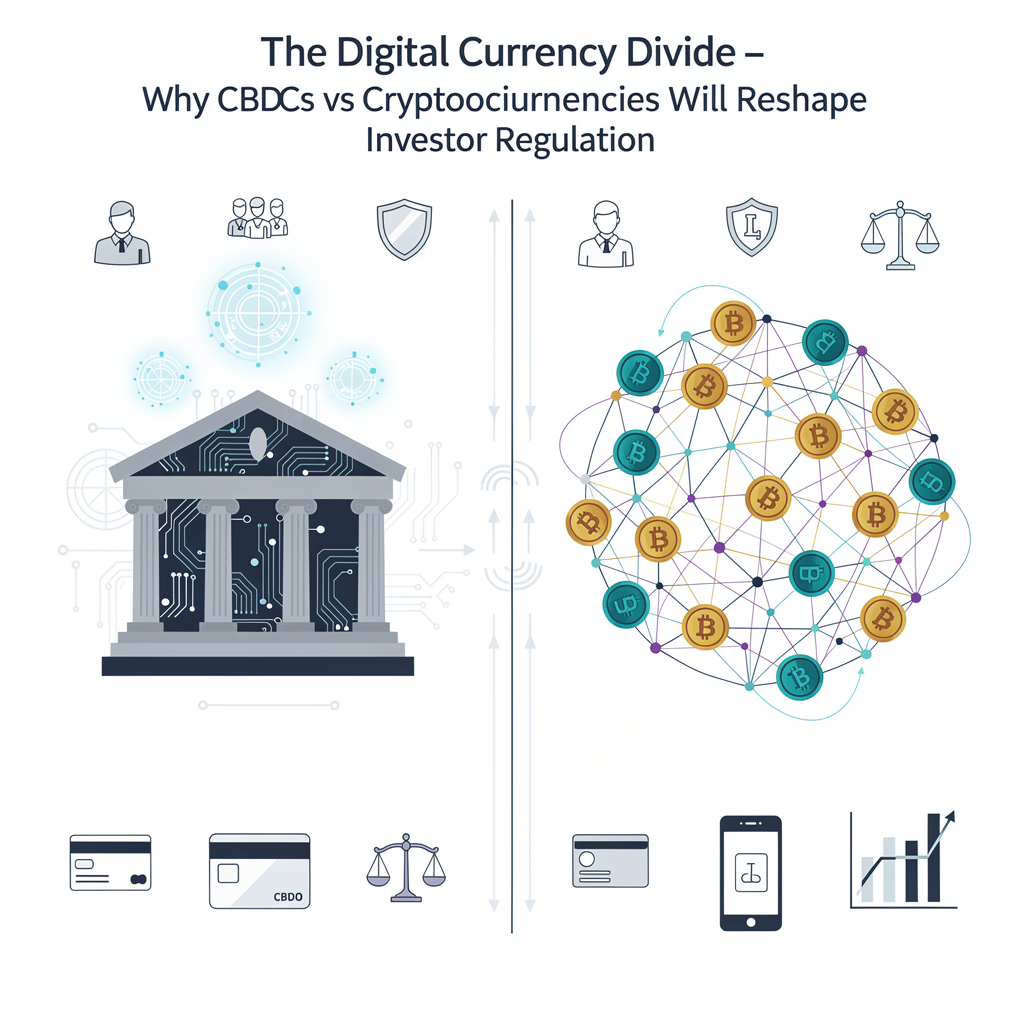
Key Summary and Implications
The landscape is tipping from a backdrop of crypto chatter into a living governance map. As regulators redraw the rules of the road, the line between state-backed money and private digital money becomes a variable that moves prices, access, and trust. For investors, the regulatory map is no longer a footnote; it’s a primary driver of risk, liquidity, and opportunity.
- The design choices of CBDCs matter as much as the existence of CBDCs themselves. Whether holdings earn interest, whether there are caps, and how accessible they are will influence consumer behavior, bank funding, and the broader demand for private digital assets.
- Private crypto markets will operate within a patchwork of regimes that increasingly favor transparency, disclosures, and regulated venues. EU, UK, US frameworks are moving toward recognizable standards, even as regional differences persist. This changes not just where you trade, but how you evaluate risk, custody, and settlement.
- Cross-border frictions and harmonization efforts will shape capital flows and arbitrage opportunities. Global interoperability and policy coordination will become a feature of asset pricing, not merely a backdrop.
- The practical takeaway isn’t simply “hold crypto or hold CBDC.” It’s a governance-aware approach: design, disclosures, and venue integrity will increasingly determine resilience and long-run returns.
Beyond the main text: deeper takeaways worth pondering
- Regulation as a determinant of product viability: regulated, transparent instruments may command lower risk premia, while opaque offerings face higher scrutiny and capital costs. This could recalibrate which crypto products survive and how liquidity is allocated.
- Custody and custody-like controls become a core investment decision: the safest pathways may hinge less on performance alone and more on governance, reserve transparency, and independent reporting.
- Investors as participants: as regimes evolve, investors can influence outcomes by engaging with regulators, choosing compliant venues, and adapting strategies in real time.
Action Plans
1) Track regulatory trajectories, not just price charts. Subscribe to official updates on MiCA, GENIUS Act, UK crypto regulation timelines, and relevant US federal actions. Create a short, portable regulatory digest and review it quarterly.
2) Reevaluate custody and trading infrastructure. Favor regulated venues with clear licensing, verifiable disclosures, and robust risk controls. Build or partner for custody solutions that offer transparent audit trails and independent reporting.
3) Build a dynamic risk model that includes policy risk. Incorporate scenarios for rapid CBDC adoption, changes in hold limits or interest features, and cross-border settlement differences. Stress-test portfolios against regulatory shocks as a core exercise.
4) Assess governance and transparency of counterparties. Prioritize issuers and platforms with regular, independent reporting of reserves, audits, and compliance metrics. Consider governance participation where feasible and practical.
5) Consider cross-border implications in portfolio design. Map how EU, UK, US, and China developments interact in your holdings and liquidity strategies, and adjust exposure to currencies and settlement rails accordingly.
Closing Message
The boundary between state money and private money is being redrawn in real time, not by a single stroke but a spectrum of choices—holdings, visibility, settlement speed, and governance. As digital euros mature, GENIUS-backed instruments evolve, and cross-border CBDCs gain traction, the real question for your portfolio becomes: how will you navigate this shifting terrain?
If this resonates, start small but think boldly: map your regulatory exposure, stress-test your assumptions, and commit to a quarterly review of how policy signals could alter your risk-reward calculus. In a world where the rulebook changes faster than prices, curiosity, adaptability, and disciplined governance are your strongest assets.
What would your next move be if a digital euro, a federally backed stablecoin, or a cross-border CBDC altered your day-to-day financial decisions?